Dispar
The Online Journal of Lepidoptera
ISSN 2056-9246
The Online Journal of Lepidoptera
ISSN 2056-9246
Abstract:The UK Butterfly Monitoring Scheme was initiated in 1976 when monitoring started on 34 sites using the standardised transect methodology devised by Ernie Pollard (Pollard et al. 1975, Pollard 1977). Of those original sites, only 5 have a more or less continuous set of data available for the subsequent fifty years. Two of these are in Dorset: Ballard Down and Studland National Nature Reserve, both in the south-east of the county near Poole Harbour. The current paper provides an account of trends at Ballard Down, while an account of trends at Studland has been published by Warren et al. (2025). The paper is not intended to be a comprehensive analysis, but an account of the main trends of resident species to celebrate the transect's fiftieth year.
Address for correspondence: martinswarren@btinternet.com
Ballard Down is an area of dry, calcareous grassland with an underlying geology of chalk rock (chalk downland). It is located in the south-east of Dorset, just north of Swanage, and is part of a chalk ridge, the Purbeck Ridge, that runs east-west for around 30 km, between Old Harry Rocks in the east and Ringstead in the west. The Purbeck Ridge is an important area for butterflies with over 30 breeding species, including national rarities such as Adonis Blue, Chalk Hill Blue, and Lulworth Skipper.
The transect runs mainly along the south-facing side of the down through areas of open grassland and along patches of scrub and light woodland that exist along the bottom of the slope (Thomas & Merrett 1980). It covers the lower, more sheltered parts of the hill between 75-100m above sea level. The highest part of the hill above reaches around 200m above sea level. The transect is approximately 5 km long and takes about 2 hours to walk. It is divided into 15 sections which align with different grazing units and features of the site (see Photos 1 & 2).
The transect covers two distinct areas that lie either side of the Ulwell Road between Swanage and Studland. On the east side of the road, the transect runs along a steep south-facing slope which is currently grazed mainly by sheep and cattle (and a few ponies from 1993-2018), whereas on the west side of the road the transect runs around both north and south facing slopes (section 10-15 on Round Down and Godlingston Down) on grassland that is grazed almost exclusively by cattle. Grazing was more sporadic during the 1970s-90s, ranging from usually heavy cattle stocking with a few ponies (mean turf height 1-4 cm) on sections 5-15 to lighter pony- or no grazing in sections 1-4 (mean turf height >8 cm tall), with no sheep during those early years (Thomas 1983a).
For some of the more sedentary species, the downland sampled by sections 1-6 (Ballard itself) supports a discrete, self-contained population that is separate from those breeding in sections 10-12 (Godlingston), or again in 13-15 (Round Down). For example, of more than a thousand adult Adonis Blues individually marked and later recaught in 1980, none was detected as moving between the three 'sites', representing a 95% probability that fewer than 2% of each population crossed the 100-110m of inhospitable habitat that separated them (Thomas 1983a).
 |
| View east along Ballard Down from Godlingston Hill, showing the two areas of downland: Round Down in the foreground and Ballard Down beyond. Ulwell village is on the right. |
 |
| Ballard Down transect route showing the 15 sections. |
Thirty-eight butterfly species have been recorded on the site of which six are vagrants, thirty-one can be considered as regular residents (breeding on site or very close by), and one as migrant/temporary resident (see list with scientific names in Appendix 1). The paper focusses on the main resident breeding species, where trends are most likely to reflect site factors.
Butterflies have been counted on the transect every week from April to September, according to the protocols used by the UKBMS (Pollard, 1977). From these weekly counts, an annual index of abundance of each butterfly species was produced by adding together the weekly counts, adding interpolated figures if there were any missing weeks (Pollard 1977). The transect at Ballard Down was walked every year between 1976 and 2025, except for 1988 and 1991 when there are gaps for much of the season due to difficulties in finding volunteers to walk the transect. It has therefore generated records on butterfly numbers recorded on the site for over 50 years. The trends are examined below and compared to UK trends as given by Fox et al. (2023) and updated on the UKBMS website.
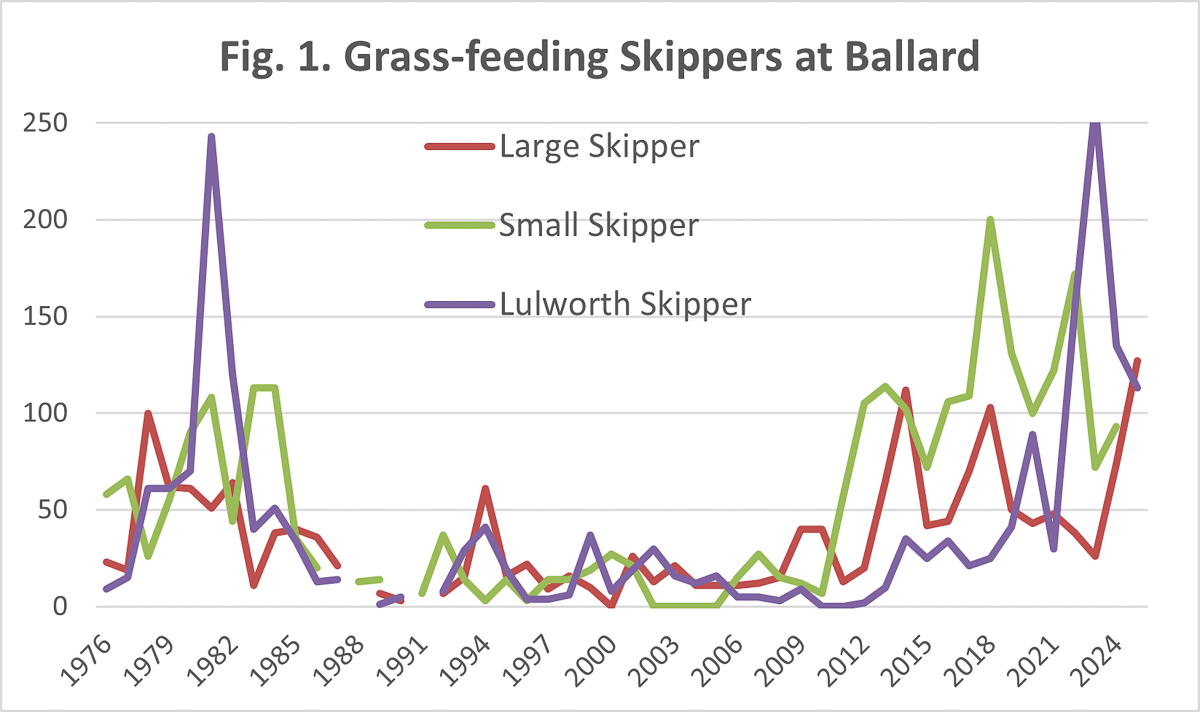
Four species of skipper have been recorded regularly: Dingy Skipper (average = 63/year), Large Skipper (37), Small Skipper (51), and Lulworth Skipper (41). Of these, the three skippers that feed on grasses and have a broadly similar trend, being abundant in the early 1980s, going through a long trough 1990-2010, after which they have all bounced back to near record levels since 2019 (Fig. 1). In the case of the Lulworth Skipper, the spike in 1981 coincided with the near abandonment of grazing in sections 2-4 and the growth of Tor Grass (Brachypodium pinnatum) into the tall clumps favoured for ovipositing (Thomas 1983b). The remaining species, the Dingy Skipper whose main larval foodplant is Bird-foot-trefoil (Lotus corniculatus), has generally increased over the last 50 years, with a noticeable peak from 2010-15, when over 100 were seen per year (Fig. 2).
A fifth species of skipper, the Grizzled Skipper, has been recorded very sporadically: singletons in 1976, 2009, 2013 and five in 1990 (8 total). It is likely that these are vagrants from small nearby colonies which now seem to be extinct in the whole of south-east Dorset.
 |  |
Five resident species are seen at Ballard Down: Small White (average = 93/year), Large White (66), Orange-tip (12), Green-veined White (10), Brimstone (4), plus the migrant Clouded Yellow, which is seen in most years (average = 12/year). Trends for all these species seem to have remained more or less stable over the last 50 years, apart from the Green-veined White which has declined by almost 50% (Figs 3 & 4). These contrast with the UK trends which show declines for Large and Small White (over 20% decline, 1976-2019) and a small decline in the Green-veined White (-14%). The erratic fluctuations of Clouded Yellow reflect both the number of springtime immigrants making landfall at Ballard and the suitability and abundance of leguminous food-plants, which hold the adults on site and lead to subsequent generations. For example, after none was seen in four of the first six years of transect recording, 112 were counted in the great 'Clouded Yellow Year' of 1983, more than double that recorded on any of 86 other BMS transects that year, and more than 30-times the number reported from the heaths of Studland, just 3 km away (Webb & Thomas 1984).
 |  |
Ballard Down is famous for having good populations of several species of blues, including the Adonis Blue (average annual count 778), Common Blue (275), Brown Argus (134), Chalk Hill Blue (62), Holly Blue (23), as well as the Small Copper (22) and Green Hairstreak (19). The Small Blue also occurs in low numbers (3) as does the Silver-studded Blue (<1), though the latter is very sporadic.
The results show that there have been large annual fluctuations of all these species, with good years and bad years, but overall, populations have remained more or less stable for the Adonis Blue, Common Blue, Brown Argus and Small Copper (Figs 5 & 6). Although there has been a substantial decline in the Adonis Blue in the last 12 years from a marked peak in 2013, the overall linear trend for the last 50 years is slightly positive. These trends mostly echo the UK trends for these species, which are categorised as stable, apart from the Small Copper which is declining in the UK as a whole. All these species are double brooded and in most years, the second generation counts of each of them (which are not distinguished in Figs 5-6) were up to 10 times more numerous than in the first (Thomas et al. 1998).
The main exception to these stable trends is the Chalk Hill Blue, which has declined dramatically at Ballard Down from an annual count of over 500 in 1976 to under 20 from 1996 onwards. Only 11 have been recorded in the last 10 years (2016-2025). This reflects a major decline of the species in Dorset as a whole, where it has disappeared from many inland sites in the last 20 years for reasons that are not clear (https://www.dorsetbutterflies.com/atlas/chalkhill-blue/). It is now rare on the whole of the Purbeck Ridge and inland Dorset, although there are still good populations on the Isle of Portland and a colony at the western end of the Purbeck Ridge at Bindon Hill near Lulworth Cove. The Chalk Hill Blue is considered stable in the UK as a whole, although 2025 was the worst ever recorded in the UKBMS.
The Green Hairstreak has also declined substantially at Ballard Down, mirroring the UK trend, though more severe (Fig. 2). Over the last 50 years it has declined by over 75% at Ballard Down and none were seen in the last two years. Given that it shares a food-plant with the Brown Argus (Common Rock-rose, Helianthemum nummularium), which has remained more or less stable, and is protected as a pupa by the same species of ant, this decline is not easy to explain.
The Small Blue is found in only very small numbers at Ballard Down and is not recorded in most years. There was a peak count of 28 in 1987 after which there were few records until 2025 when 18 were recorded. Its food-plant Kidney Vetch (Anthyllis vulneraria) was formerly rare on the site but has increased markedly in recent years (notably in section 11). The butterfly may now have a more established colony, with eggs found regularly on Kidney Vetch flowers, especially in section 2 and 4, even in years when the less conspicuous adults were not recorded on transects.
The Holly Blue, which feeds mainly on Holly and Ivy in this region, has undergone huge fluctuations but has generally increased over the last 50 years.
The Silver-studded Blue is also recorded occasionally on the site (less than 1 every 10 years), which probably represent vagrants from nearby heathlands where it is abundant (Warren et al. 2025).
 |  |
Several species are seen at Ballard Down, though most are recorded in low numbers and breeding of these mobile species partly depends on conditions in the surrounding countryside. They include Peacock (average = 31/year), Red Admiral (29), Small Tortoiseshell (28), Painted Lady (13), Comma (12), and Silver-washed Fritillary (0.4). Numbers of Red Admiral and Comma have generally increased; Peacock has remained stable, and Small Tortoiseshell has declined. All these broadly reflect UK trends (Fig. 7 & 8). The Silver-washed Fritillary is recorded very sporadically and is unlikely to breed on the site. In addition, two Marsh Fritillary were recorded in 2025, almost certainly releases as the species has no breeding colonies in the Purbeck area.
The only resident fritillary species is the Dark Green Fritillary (average = 30/year), which has increased overall but with long term fluctuations (Fig. 12). It started off quite abundant in the late 1970s (max 58/year), went through a long trough from 1985-2010 when fewer than 15 were seen per year, after which it increased dramatically to a peak of 156 in 2019 only to fall back to 19 and 29 in the last two years (2024 and 2025 respectively).
 |  |
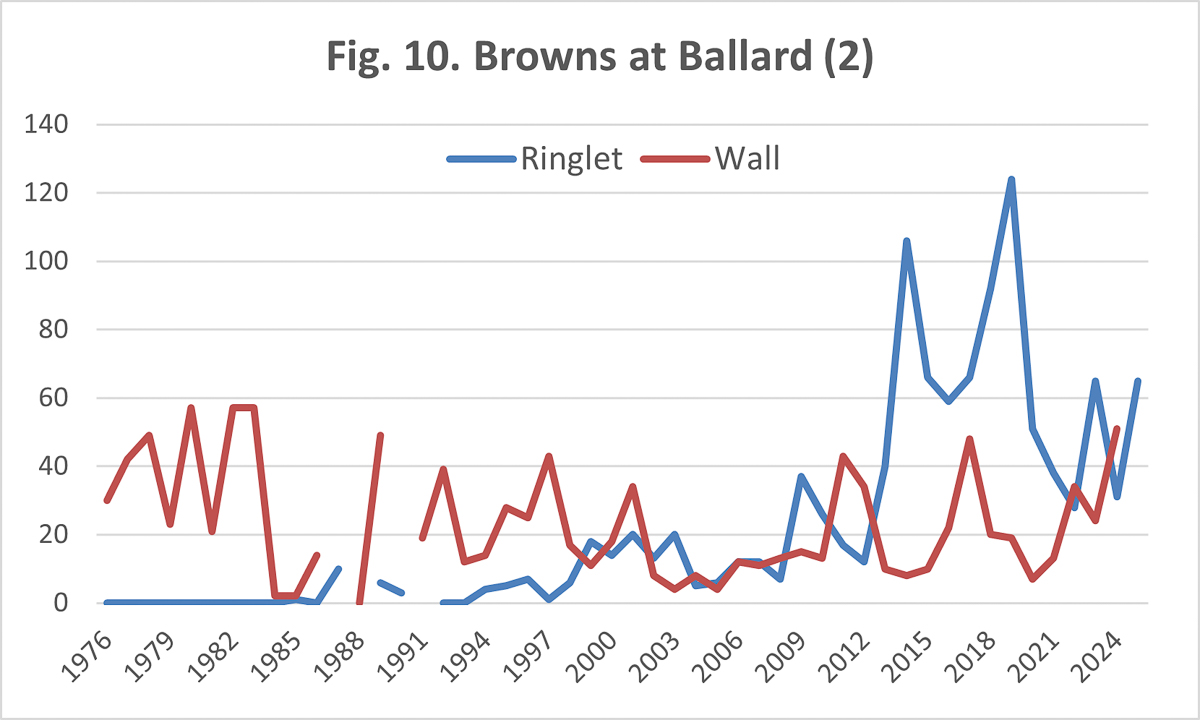
Several species breed on the site, some of them in large numbers. They include Meadow Brown (average = 1044/year), Gatekeeper (479), Marbled White (345), Speckled Wood (239), Small Heath (150), Wall (24), Ringlet (23), and Grayling (18). Most of these species are stable, but there have been large increases in Ringlet and Marbled White, especially since 2013, and a small increase in Speckled Wood (Figs 9-11). These trends largely reflect UK trends.
The only species of this group to have declined is the Grayling, which had a peak annual count of 206 in 1979, but has since declined so that fewer than 10 a year have been seen in the last two decades (and zero counts are common, see Fig. 12). This generally reflects the UK trend, where there has been a decline of 72% between 1976-2019 (Fox et al. 2023). It seems likely that there is still a small breeding population of the Grayling at Ballard Down, but there are large populations on nearby heathland which may supplement this population and allow it to recolonise if it becomes temporarily extinct on the site (a rescue effect).
 |  |
 |  |
The clear winners at Ballard Down over the last 50 years are: Dark Green Fritillary, Speckled Wood, Marbled White, which all generally mirror nationally increases in abundance. However, two other winners, the Large and Small White have increased despite having declined in the UK.
Two other species, the Large and Small Skipper, have done well in recent years, while populations have declined in the UK as a whole. However, they underwent a long period of low numbers in the 1990s and 2000s, from which they have dramatically bounced back.
The Lulworth Skipper has followed a similar fall and rise as the Large and Small Skipper, which reflects UK trends of this species, which is confined to nearby areas in Dorset.
Three species have done particularly badly at Ballard Down: Grayling and Green Hairstreak, which both mirror national declines; and the Chalk Hill Blue, which reflects a decline across most of Dorset but not the rest of the UK where it is more or less stable.
The majority of other species at Ballard Down have remained more or less stable over the last 50 years, including rare and local species such as the Adonis Blue, Brown Argus, and Dingy Skipper. However, a few species that are stable at Ballard Down are declining nationally, including the Small Heath and Wall.
Over the last fifty years, the weather in south-east Dorset has changed considerably. The summer temperature has increased by almost 1.5°C and the spring temperature by almost 2.5°C (Figs 13 & 14, taken from the nearest long term weather station at Hurn, 16km away). This may account for the increases of some species, which may have benefited from the generally warmer weather. For example, the Speckled Wood has spread north in the UK in the last 50 years as well as increasing in numbers, almost certainly due to climate change (Fox et al. 2023). It seems unlikely that the warming weather has caused the decline in Grayling, Green Hairstreak and Chalk Hill Blue as these have done reasonably well on other sites in the UK, but further research is needed to be certain.
 |  |
The amount of rainfall has increased slightly over the last fifty years, and there have been periods of either very high winter and spring rain (e.g. 2014) or summer rain (e.g. 2012), which may have affected some species (Figs 15 & 16). But perhaps the most profound impact may be from a lack of rain in certain years that resulted in prolonged summer droughts. They start with the severe drought of 1976, but were followed by others in 1984, 1995 (which had less rain than in 1976), and 2022 (Fig. 16). Other dry summers have been 1982, 1984, 1994, 2006, 2013, and 2018, each of which had less than 100mm of rain in the 3 summer months from June to August (Fig. 16). During the extreme dry periods, the south facing slopes at Ballard Down completely dried up, with virtually no flowers available for nectar or palatable foodplants for egg-laying and larvae. A few species like the Dingy Skipper and Green Hairstreak crashed after the extreme 1976 drought, and again in 1995, and drought periods also led to dips in other species. However, they had a surprising little impact on many butterflies, most of which were either unaffected or bounced back quickly.
 |  |
We have not investigated the impact of habitat management in any detail as there are no comprehensive records of how this has changed over the years, and the effects are likely to be complex. One notable effect was the clearance of scrub and trees in section 5 around 2010, which resulted in a large increase in several species there, including the Brown Argus. Also, the high numbers of Adonis Blue in 2016-18, coincided with some years when ponies were grazed in sections 2-3, and the likely host ants Lasius alienus and Myrmica sabuleti were prolific.
We mention in the introduction that the sections to the west side of the road (sections 10-15) are grazed exclusively by cattle, whereas the sections to the east side (1-9) are grazed currently by sheep, though in the early decades these were often ungrazed or lightly grazed. We think that sheep grazing was started in the 1990s. It would be interesting to compare trends on each of these areas, though this is likely to be complex and beyond the scope of the current paper.
Ballard Down remains a very important habitat for butterflies in south-east Dorset and has maintained good populations of many species, including rare and local butterflies like the Dark Green Fritillary, Adonis Blue, Brown Argus, Small Copper, Lulworth Skipper and Dingy Skipper. The three species that have undergone big declines (Grayling, Green Hairstreak and Chalk Hill Blue) all reflect either national or local declines. However, the causes of these widespread declines are not clear and require further research. They may be due to nitrogen deposition, climate change, changing habitat management, or other factors that are currently not known.
The butterflies that have done well at Ballard Down include a wide range of species, each with very different habitat requirements. Some are grass feeders (e.g. skippers), some feed on low growing flowering plants (e.g. blues and Dark Green Fritillary), some require short turf (e.g. Adonis Blue and Dingy Skipper) whilst many require taller vegetation (e.g. skippers, Dark Green Fritillary, and Marbled White). The success of such a wide range of species may in part be due to the heterogeneous nature of the site itself, with a varied topography and two distinct parts that are grazed differently: one currently by sheep, the other by cattle, whilst in earlier decades most was cattle grazed and the eastern slopes often left fallow. Most of the site is south facing downland with large areas of short vegetation, but there are areas with both north and west facing slopes that provide moister conditions. There are also parts of the site that are naturally taller and scrubbier, which provide habitats for species that prefer long vegetation.
Despite the weather extremes that have occurred over the last fifty years, populations of most species have bounced back and remained healthy. This again suggests that the varied nature of the habitat, and the resilience it gives to the butterfly breeding conditions, may be a major key to the site's success.
The other factor that undoubtedly contributes to butterfly survival at Ballard Down is its connectivity within the surrounding landscape. Even within the grasslands sampled (photos 1, 2), the main swards support up to three demographically-separate populations of some of the more sedentary residents, adding further resilience to their persistence. Likewise, it lies in a region that contains a lot of semi-natural habitat, including the 30km length of the Purbeck Ridge and the limestone cliffs to the south, both of which provide large areas of downland habitat. There are also vast areas of heathland just to the north, which no doubt bolster populations of species like the Grayling. The site is therefore very well connected in the landscape, which allows for genetic interchange with other sites as well as rescue effects across metapopulations whenever individual populations become low or die out (e.g. after droughts).
The monitoring of butterflies at Ballard Down over the last fifty years has given us a unique insight into long-term changes in butterfly populations on an important site in the UK. It will be interesting to see what the next fifty years brings as the climate warms further and the butterflies are put under more stress.
Fox, R., Dennis, E.B., Purdy, K.M., Middlebrook, I., Roy, D.B., Noble D.G., Botham M.S. & Bourn N.A.D. (2023) The State of the UK's Butterflies 2022. Butterfly Conservation, Wareham, UK.
Pollard, E., Elias, D.O., Skelton, M.J. & Thomas, J.A. (1975). A method of assessing the abundance of butterflies in Monks Wood National Nature reserve in 1973. Entomological Gazette 26, 79–88.
Pollard, E. (1977). A method for assessing changes in the abundance of butterflies. Biological Conservation 12, 115–134.
Thomas, J.A. (1983a). The ecology and conservation of Lysandra bellargus (Lepidoptera: Lycaenidae) in Britain. Journal of applied Ecology 20, 59-83.
Thomas, J.A. (1983b). The ecology and status of Thymelicus acteon (Lepidoptera: Hesperidae) in Britain. Ecological Entomology 8, 427-435.
Thomas, J.A. & Merrett, P. (1980). Observations on butterflies in the Purbeck Hills in 1976 and 1977. Proceedings of the Dorset Natural History & Archaeological Society 99, 112-119.
Thomas, J.A., Surry, R., Shreeves, W., Steele, C. (1998). New atlas of Dorset butterflies. 116 pp. Dorset Natural History and Archaeological Society, Dorchester.
Warren, M.S., Rich, S. and Haywood N. (2025). The dramatic rise of the Silver-studded Blue, Plebejus argus, over 50 years at Studland Heath National Nature Reserve, Dorset, UK. [online]. Available from http://www.dispar.org/reference.php?id=196.
Webb, N.R. & Thomas, J.A. (1984). The clouded yellow (Colias croceus) in Dorset during 1983. Proceedings of the Dorset Natural History & Archaeological Society 105, 173-174.
We would like to express our deep gratitude to all the transect walkers who have walked the transect at Ballard Down over the last 50 years: Jeremy Thomas, Peter Merrett, Colin Nunn, Peggy Taylor Jon Bellamy, Lorraine Munns, and many others who have helped. JT thanks Phil Grey for introducing him to the Ballard circuit in 1975 and suggesting its suitability for a transect walk.
We would also like to thank the farmers who manage the site on behalf of the National Trust and Wessex Water. Finally, we would like to thank the UK Butterfly Monitoring Scheme (run by the UK Centre for Ecology and Hydrology and Butterfly Conservation) for starting the scheme and providing the platform for entering the weekly data.
 |