Dispar
The Online Journal of Lepidoptera
ISSN 2056-9246
The Online Journal of Lepidoptera
ISSN 2056-9246
 |
by Tom Jackson.
The essential illustrated guide to the ingenious techniques that insects use to design and construct an astounding array of natural structures, from nests to shelters to traps.
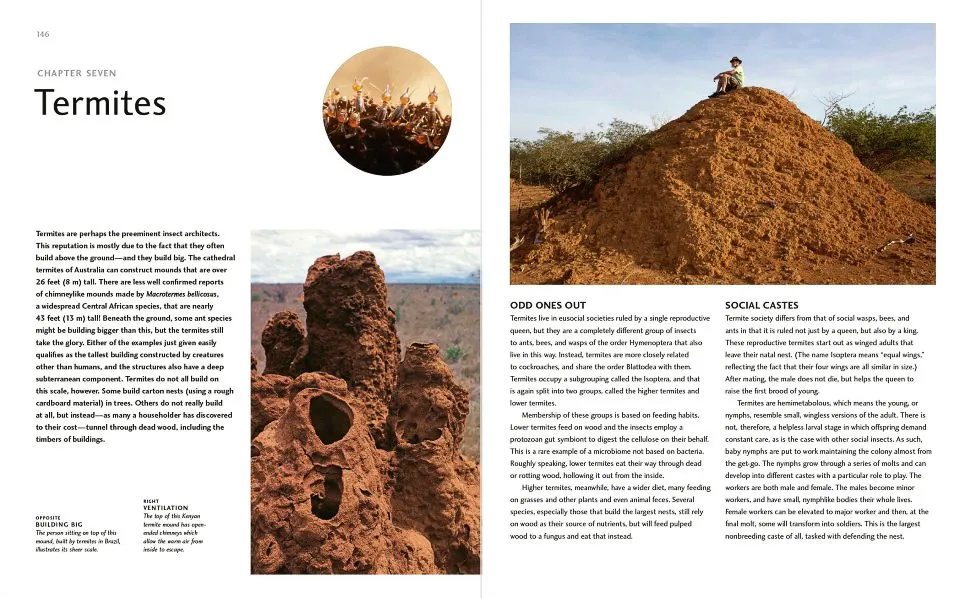
Insect Architecture takes you inside the amazing structures that insects build, from the paper galleries of yellowjacket wasps to elaborate termite mounds complete with royal chambers and air-conditioning systems. Each chapter focuses on a group of insect architects, describing the materials and methods they use while exploring the structures themselves in detail. Blending spectacular illustrations with illuminating case studies of representative species from around the world, this is the ultimate guide to insect artistry, innovation, and design.
Long before Homo faber was so much as a twinkle in evolution's eye, insects were building edifices that would humble our greatest architects. In his introduction to this fascinating book, Jackson notes that scaled up to human dimensions, an average cathedral termite mound would rise higher than anything yet built by humans and the underground nest of a leaf-cutter ant would be the size of Paris. Nor is it all about size. The homes, defences and snares of many species are marvels of ergonomics and ingenious design, sometimes created by individuals, sometimes by vast teams of perfectly coordinated labourers. As Michael Engel aptly says in his foreword, quoting the Book of Proverbs, 'Go to the ant, thou sluggard; consider her ways, and be wise.'
Each chapter of Insect Architecture consists of a set of related case studies illustrating the extraordinary ways insects manipulate their environment to optimise breeding and survival. Each set is introduced by a 'blueprint' - a generic section dealing with a group, medium or idea (for example, 'Beetles and Bugs', 'Wax and Foam', 'Webbing and Cases') - and an account of the materials, features and sometimes behaviours shared by the chosen species. There follow the individual monographs, treating in more detail a single species, genus or broader taxon, showing how the blueprint is applied in particular cases. These make for intriguing and, to me, eye-opening reading. I had no idea of the way jewel wasps enslave zombie cockroaches with a venom that nullifies their escape reflex, nor of how periodical cicadas synchronise their emergence to prime-number cycles of years, so predators with shorter life cycles cannot in turn synchronise with them. The accounts are brought to life with stunning photographs - some taken in nature, others more staged - and drawings.
 |
The style is rigorous but not overly scientific, making the book accessible to a lay reader. Its format makes it perfect for dipping into, rather than reading in one go, but I did enjoy the grouping into chapters of related strategies and these are certainly worth reading together. It is not, of course, comprehensive. You will search in vain for an account of how white admiral caterpillars construct their faecal projections or cut and sew themselves into their hibernacula. Instead, via the case studies, you are introduced to the broad spectrum of insect building activity, giving you a greater insight into what might be involved in those particular cases not mentioned.
 |
Above all, this book treats insects as the underrated geniuses that they really are, rather than the annoying bugs and creepy-crawlies so many see them as. Long after Homo sapiens is a distant evolutionary memory and all his great works have crumbled into dust, the humble insects will still be constructing their own wonderful cathedrals, nurseries and tombs. The irony of this will be lost on them, of course, because they will have no time for reflection and philosophy - they will be too busy building.
 |