Dispar
The Online Journal of Lepidoptera
ISSN 2056-9246
The Online Journal of Lepidoptera
ISSN 2056-9246
 |
by Jean-Pierre Moussus.
A comprehensive photographic field guide to the butterflies and caterpillars of Britain and Western Europe - as well as the Canaries, the Azores, Madeira, and Cyprus. This is the first field identification guide to the adult butterflies of Britain and Western Europe that also covers most of their caterpillars and egg types, providing all the tools needed for accurate identification. Comprehensive, practical, and easy to use in the field, this superb photographic guide covers all of the 472 species of butterfly found in Britain and Western Europe - as well as the Canaries, the Azores, Madeira, and Cyprus. Using the most recent taxonomy, it is also the first European butterfly field guide to use identification keys, including images of genitalia to distinguish between similar-looking species. The keys also include biogeographic and ecological identification criteria. Complete with an introduction on the biodiversity and biogeography of European butterflies, this is an essential guide for all lepidopterists and entomologists, from amateur enthusiasts to professionals.
There has been the need for an affordable, revised and updated field and identification guide to the Butterflies of Europe for some years now, necessitated by significant changes in the distribution and taxonomy of our European butterfly fauna, and the colonisation of several new species from the African continent. This recent publication aims to fulfil this requirement, following as it does in the footsteps of revered former books such as Butterflies of Europe (Lafranchis, 2004); Collins Butterfly Guide (Tolman and Lewington, 1997); and A Field Guide to the Butterflies of Britain and Europe (Higgins and Riley, 1970).
Originally published in French in 2024, this translation by Jean-Pierre Moussus is now available in English and covers more than 470 species. The introductory section discusses the geographical range and species selection for this work, before looking at European species density and the effects of Pleistocene glacial refuges and post-glacial recolonisation on the current distribution of our continental butterflies, along with the isolating effects of island geography. This is followed by an assessment of threats in terms of habitat degradation and climate change.
After a brief summary of how to use the field guide, we enter the identification key, which spans almost 100 pages and is by far the most comprehensive ID key yet published on this group of invertebrates in a book of this size. Next, we arrive at the main substance of the work, a series of monographs on the individual species. Almost all species are allocated a page of their own, with a few cryptic or closely related species grouped together on one page (e.g. Wood White/Cryptic Wood White/Real's Wood White; Canarian Brimstones/Madeiran Brimstone). The monographs follow a standard format throughout, beginning with a series of illustrations, often, but not always, showing male and female upper sides and undersides, with useful annotations pointing out distinguishing features. Below this, a brief text is split into 8 sections: Habitat; Hibernating stage; Elevational Range; Egg-laying; Flight Period; Host plants; Diversity and systematics; and an interesting, sometimes anecdotal section denoted "Did you know?", which draws attention to a particular feature of the butterfly's individual biogeography, behaviour, history or ecology.
 |  |
But alongside the text is where the book really comes into its own. As well as a distribution map, (which of necessity in a work of this scope is rather broad-brush and only gives an idea of the range, rather than detailed local distribution patterns), we find a series of cleverly designed pictograms, which add a large amount of information in a very economical fashion. The first of the pictograms next to the map shows the conservation status in Europe, as defined by the criteria applied in the IUCN Red List. Unfortunately, due to the timing of this publication, these are based on the 2010 assessment, rather than the recently updated 2025 assessment, therefore many of the pictograms are already out of date (e.g. Nevada Grayling, 2010 assessment - Least Concern; 2025 assessment - Critically Endangered). The next pictogram classifies how vulnerable to extinction the species is believed to be due to climate threat; this is one of several new metrics used in this publication, and is split into green, amber and red, representing respectively, low, moderate and high risk; some species are allocated a grey pictogram, indicating the species has not been assessed, or is considered to be poorly influenced by climatic factors. Then comes a pictogram denoting voltinism; one, two or three+ broods per year, including a numeric of 0.5 for certain species that overwinter twice and therefore, despite flying every year, have a brood frequency of once every two years. A unique table is included for almost every species showing, again in pictogram format, details of adult food preferences, behaviour of males, and dispersion tendencies, alongside larval food type, caterpillar location and chrysalis location.
 | 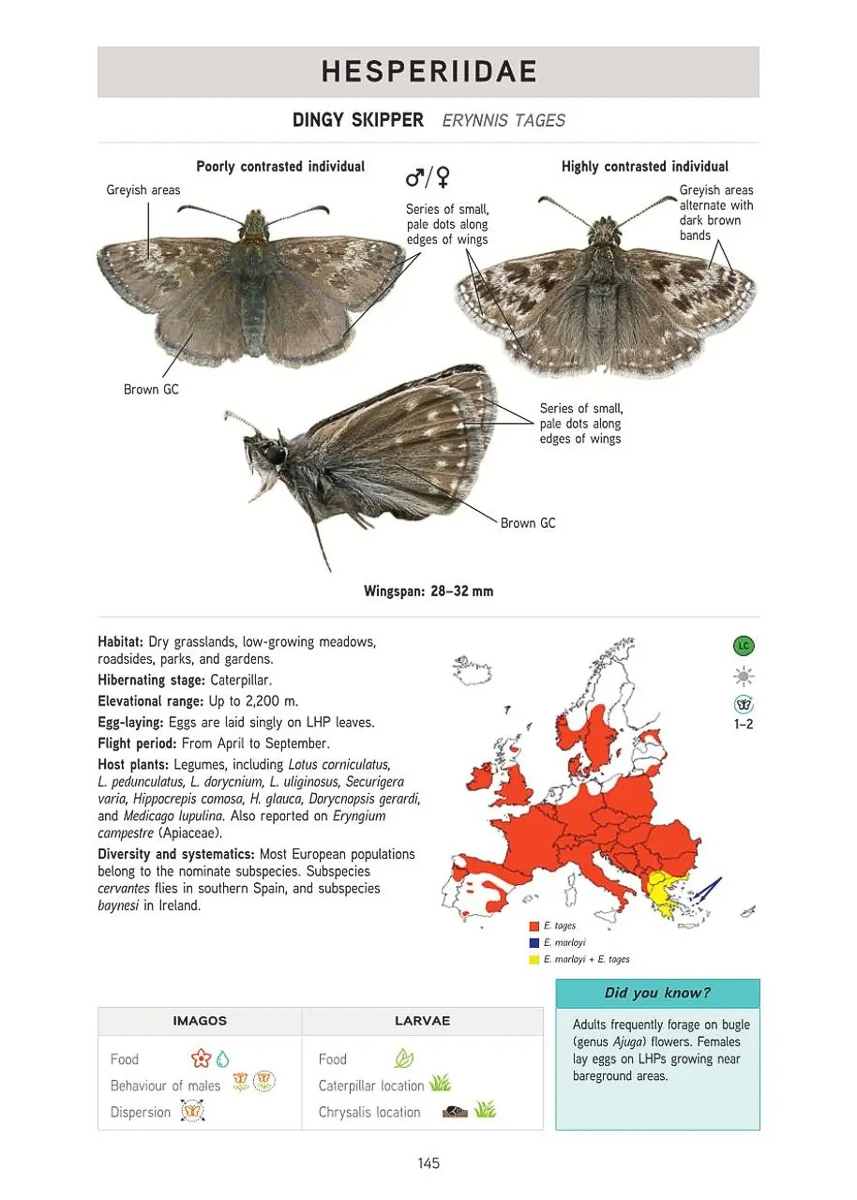 |
I found the male behaviour details and dispersion information particularly fascinating: male mate-location behaviour is split into four categories: patrolling behaviour; territorial perching with aggression; territorial perching without aggression; lekking (includes hill-topping and tree-topping), or sometimes a combination of several behaviours. Dispersal habits are similarly a new metric to me in terms of butterfly field guides, also of great interest, although I did find a small number of example where I didn't completely agree with the assessment given (e.g. Brown Hairstreak). Species are rated as having low, moderate or strong dispersal tendencies. Additionally, for species known to be regularly migratory in habit, a bidirectional double-arrow is added to this pictogram.
 |
At the end of the book is an introduction to the use of genitalia for identification of a selection of difficult species, followed by a guide to the caterpillars (with images of final instars only) and key egg types. None of these are fully comprehensive but may be an interesting adjunct for some readers.
 |  |
Inevitably one or two errors or inconsistencies will creep into any publication; for example, the pedant may pick up on the statement that the britannicus subspecies of the Swallowtail flies "in the NE of the UK", or note that Euchloe bazae is called the Spanish Greenish Black-tip on the page title, but referred to as the Iberian Greenish Black-tip in the text. [This name mismatch doubtless arises from the fact the present edition is translated from an original French version (PAPILLONS de jour d’EUROPE OCCIDENTALE, Delachaux et Niestlé, 2024): the butterfly is known as the Piéride Soufrée Ibérique in French. A few other translation literalisms/solecisms slip in (thus, 'dessins' is occasionally translated as 'drawings' rather than 'markings' and 'pupillée de blanc' becomes 'white-pupillated') - G.Padfield, pers.comm.].
Such minor glitches however are few and far between, and overall, this is a solid, very high-quality piece of work, thoroughly researched and referenced, intelligently designed and beautifully presented, if a little weighty at 1.4kg to be portable enough to take out into the field. It addresses most of the recent changes in abundance and nomenclature, adds a lot of new information not previously available, and in the space of a couple of weeks has become my latest "go to" reference work on the subject.
Yes, it has some limitations: local forms and subspecies are mentioned briefly by name in the text under "diversity and systematics" but are not described, nor illustrated in the ID key, so the reader may struggle to identify some of the regional forms of more variable species such as, for example, the Large Grizzled Skipper. Similarly, the book cannot be considered an ID guide for the caterpillars, as the early instars, often very different in appearance to the fully grown larva, are not included.
Despite these minor shortcomings, this book represents great value for money and I would strongly commend this tome to anyone - from newcomer to experienced European field Lepidopterist. It is worthy of a place on any bookshelf and in any library; in fact, I would have no hesitation in saying that it is an essential purchase.