
Dispar
The Online Journal of Lepidoptera
ISSN 2056-9246
The Online Journal of Lepidoptera
ISSN 2056-9246
Abstract:The Silver-studded Blue, Plebejus argus, is a highly localised butterfly in the UK, which is found on heathland, limestone grasslands and other specialised habitats in the southern half of the country. The study examines its dramatic rise over the last 50 years at Studland National Nature Reserve in Dorset, which has an unbroken record of trends since 1976. The butterfly has increased even more rapidly over the last 14 years, far greater than on other heathland sites in Dorset.
There is little habitat management on the reserve so the increase is something of an enigma. We speculate on possible factors that might be causing the increase, including winter waterlogging, levels of nitrogen deposition, an increase in the host ant L. niger, and reduced predation or parasitism (possibly caused as a result of the winter waterlogging).
We compare trends from Dorset heathlands with those on limestone quarries on the Isle of Portland, where numbers have crashed, almost certainly due to loss of bare ground patches as the quarries have become overgrown. We also compare trends in the Silver-studded Blue with another heathland specialist, the Grayling, Hipparchia semele, which has undergone more modest increases.
Address for correspondence: martinswarren@btinternet.com
The Silver-studded Blue, Plebejus argus, is a highly localised butterfly in the UK, which is found in specialised habitats in the southern half of the country. The distribution of the species has declined by 71% since 1800 (Asher et al., 2001) and it is classified as Vulnerable in the latest Red List of UK Butterflies (Fox et al. 2022).
The most widely used habitat is heathland, which occurs on poor, acidic soils and is dominated by low shrubs such as Ling (Calluna vulgaris) and other heathers. Other habitats include calcareous grasslands, sand dunes and mosses.
In Dorset, the Silver-studded Blue occurs widely on heathlands in the south-east of the county as well as on limestone grasslands in disused quarries on the Isle of Portland. The former habitat was once far more widespread in the county but has been reduced by 85% in the last 150 years (Rose et al. 2020). On Portland, the butterfly was widespread during the 1980s (Warren 1986), but most of the quarries on Portland have been abandoned for several decades and are now becoming more vegetated and scrubbed over. This has led to a serious decline in the butterfly.
This study describes changes in numbers of Silver-studded Blues on several standard butterfly transects that have been established in Dorset as part of the UK Butterfly Monitoring Scheme (UKBMS). The longest running of these is at Studland Heath National Nature Reserve, which was established in 1976 as one of the first tranche of transects which later became the UK Butterfly Monitoring Scheme. The data in this paper covers the period up to and including 2025, giving a 50-year unbroken record of annual changes on this site. It is one of only five sites in the UK that have such an unbroken record. From 2011 onwards an additional transect was added at Studland NNR called Ferry Road West (FRW), which runs on Plateau Heath just a few hundred metres to the west of the original transect. The trends on these two sites are compared with those on other transects with Silver-studded Blue in Dorset, both on heathland and limestone grassland. A comparison is also made between trends of this butterfly and another heathland specialist, the Grayling, Hipparchia semele.
Adults emerge in mid-June on Dorset heathlands and fly for 6-8 weeks until mid-August. They lay their eggs singly, either low down on one of the food-plants or more often nearby, close to the ground on woody vegetation or mosses (Ravenscroft & Warren, 1996; pers. obs.). They overwinter in this stage and hatch in early spring to begin feeding on leaves of the food-plants. In Dorset they are mainly found in areas of wet heathland, dominated by Cross-leaved Heath (Munns 1977), while on Portland they are found in short or sparse vegetation, typically with some bare ground where the leguminous food-plants are present (Warren 1986).
Silver-studded Blue larvae feed on a wide range of Ericaceous and Leguminous plants. On heathland these include Ling (Calluna vulgaris), Cross-leaved Heath (Erica tetralix) and Bell Heather (Erica cinerea). On limestone grassland on Portland, food-plants include Horseshoe Vetch, (Hippocrepis comosa), Common Rock-rose (Helianthemum nummularium) and Bird’s-foot-trefoil, Lotus corniculatus (Warren, 1986).
The butterfly has a very close symbiotic relationship with ants, which on heathland are primarily Lasius niger (Munns 1977) while on limestone grassland on Portland they are typically associated with Lasius alienus (Thomas et al. 1999) though they may also use L. niger as well as this is abundant in some of the quarries (Lorraine Munns, pers.comm.). The relationship is highly evolved and females only lay eggs where they detect the presence of the host ants. During the following spring, the ants tend the young larvae constantly and the larvae rest in ants’ nests during the night. They may even be taken in and out by ants when they are young. The larvae have special organs that attract ants and a honey gland that produces a sweet secretion that ants consume. The ants protect the larvae from predators and probably parasitoids in a mutually beneficial relationship. The larvae pupate on the ground, or under stones, where they continue to be tended by ants. The emerging adults are also tended by ants while they unfurl their wings and take flight.
The Grayling flies from early July to late August and lays it eggs singly on tufts of grasses growing amongst or next to bare ground. On heathland the larval food-plant is mainly Bristle Bent (Agrostis curtisii), while on limestone grassland on Portland it is other fine leaved grasses, probably Early Hair-grass (Aira praecox), Sheep’s Fescue (Festuca ovina) or Red Fescue (Festuca rubra). The larvae hatch after a few weeks and overwinters in their third instar at the base of a grass tussock. They resume feeding the following spring and pupate on the top of the soil in an earth cell, spun with a small amount of silk. The Grayling has no association with ants and is usually found along trackways where it basks on bare ground.
The main study site is Studland Heath National Nature Reserve in the south of Dorset, close to the sea and Poole harbour. The reserve is an extensive area (631 ha) of wet and dry heathland with patches of gorse (Ulex spp.) scrub and seedling birch (Betula spp.) or pines (Pinus spp.), with a few areas of willow carr (Salix spp.) and mixed woodland. The Silver-studded Blue occurs mainly in areas of open wet heathland that are dominated by Cross-leaved Heath (Erica tetralix). There is little management of the site apart from scrub control and removal of invasive pines, the cutting of fire breaks along the main tracks, and occasional (mainly accidental) wildfires.
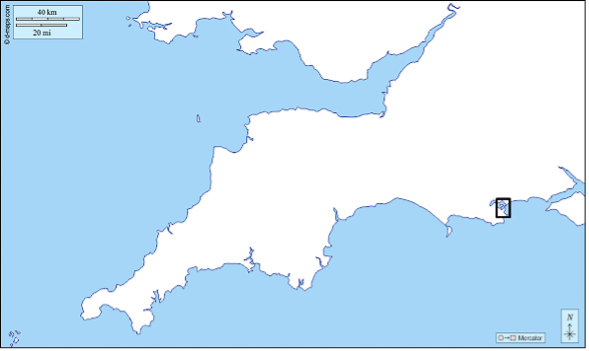 |
| Location map of the Studland Peninsula in south-west England |
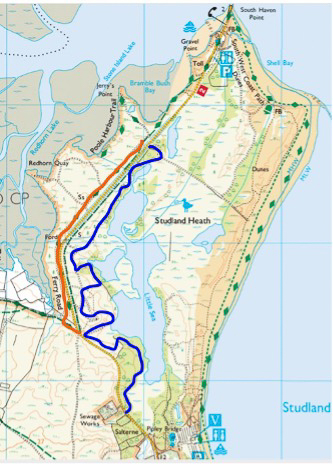 |
| The routes of the transects at Studland NNR (blue) and Ferry Road West (Red) (© Ordnance Survey/Bing Maps) |
We compare the trends at Studland with eight other heathland sites that are further inland in Dorset: Hethfelton Wood, Kinson Common, Moors Valley Country Park, Slop Bog, Sopley Common, Stoborough Heath, Tadnoll and Upton Heath. We also compare trends with those on the Isle of Portland, where there are two long running butterfly transects in abandoned limestone quarries: Broadcroft Quarry (managed as a Butterfly Conservation reserve from 1993-2018) and Tout Quarry. The former has received scrub control and occasional grazing by ponies since quarrying stopped in 1999 when part of the quarry was backfilled with landfill waste and capped with soil. Most of the grassland is closed and quite tall, but several artificial scrapes were created in 2003 to create bare ground areas (de Whalley et al. 2006). Some of the were re-scraped in 2025 and new scrapes created. In contrast, Tout Quarry was not infilled and has been left to regrow naturally. It has not been managed since 1982 and is a mix of scrub and limestone grassland with patches of bare ground.
The population of Silver-studded Blue at Studland has been monitored by a butterfly monitoring transect that was established in 1976. Butterflies have been counted on the transect every week from April to September, and an annual index of abundance of each butterfly species was produced by adding together the weekly counts (Pollard 1977). This transect has generated 50 years of unbroken records on numbers of Silver-studded Blue as well as other heathland butterflies like the Grayling. The Studland NNR transect winds in and out of areas of woodland and open heathland, just west of the Little Sea, an area of open water within the Studland peninsula.
The transect at Ferry Road West (FRW) was established in 2011 and runs c100m to the west of the original transect, along the western side of Ferry Road in an area known as Plateau Heath. The transect traverses mainly open heathland with occasional patches of gorse scrub. The Studland NNR transect is approx. 3.1 km long, while the FRW transect is approx. 1.8 km long.
 |
| Typical section of the Studland NNR transect |
 |
| Ferry Road West transect |
The transect results show that the Silver-studded Blue increased slowly on the Studland NNR until 2018 when it showed a marked increase (Fig. 2). The overall increase in the index of abundance over the last 50 years is around 3600% (from an average of 16 in the first 3 years to 575 in 2025). At Ferry Road West (FRW) it has increased slowly since 2012, but with a marked increase since 2017. The overall increase in abundance in the 14 years since 2011 has been a remarkable 798% at Studland NNR and 1,400% at FRW. The density of adults in the last two years has been astonishing, with a peak of 548 seen on a single transect at FRW, with 1 per metre in some sections.
 |
To put these results in context, we looked at trends on five other inland heathland sites in Dorset with long running transects: Hethfelton Wood, Slop Bog, Sopley Common, Stoborough Heath, and Tadnoll. Here the Silver-studded Blue has also increased over the last 14 years but only by an average of 180% (Fig.3).
 |
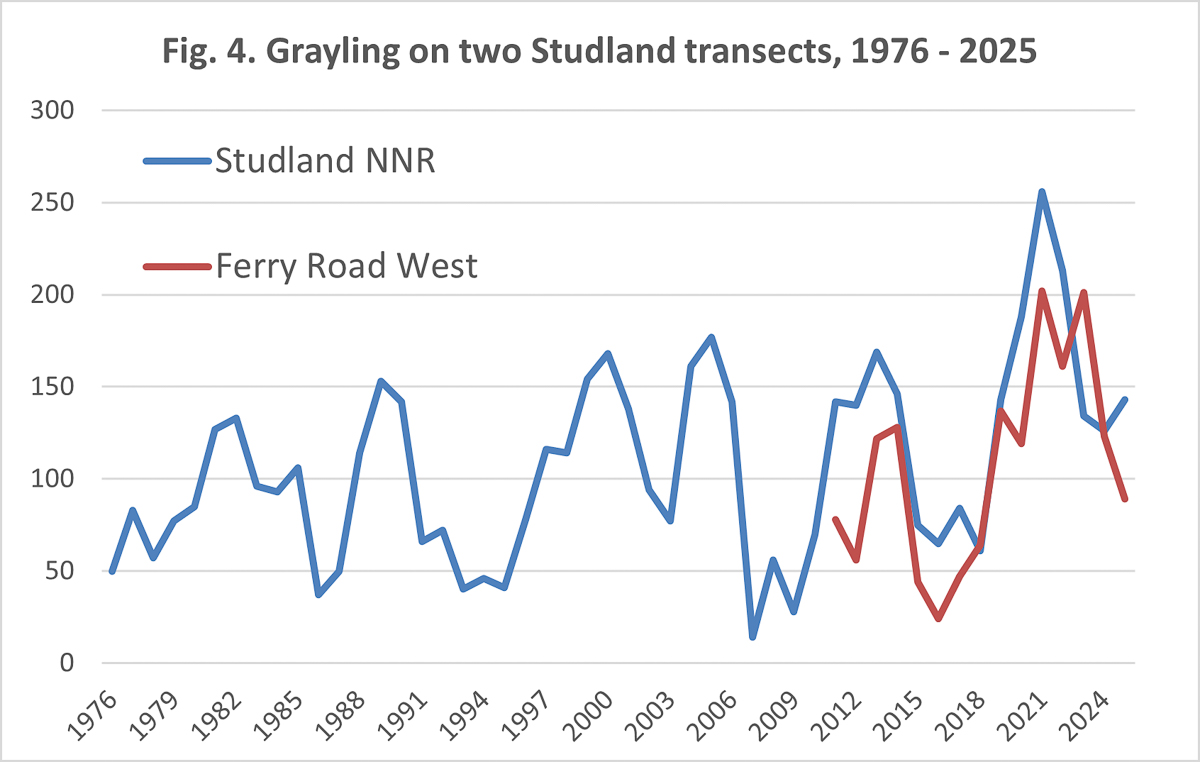
We also compared trends of Silver-studded Blue with another UK heathland specialist butterfly, the Grayling. Numbers of this species are characterised by large fluctuations but it has increased at Studland NNR by 286% since 1976 - a far lower rate than the Silver-studded Blue (See Fig.4). Since 2011 it has remained more or less stable at Studland NNR and has increased by c14% at FRW following a large drop in 2015. The linear trend has increased by an average of 250% over the period.
 |
We compared trends of Grayling at Studland with seven inland heathland sites in Dorset. Here the butterfly has also fluctuated widely, but numbers have remained more or less stable since 2008 (Fig.5).
 |
The trends of the Silver-studded Blue and Grayling in the limestone quarries on Portland show a marked difference to those on heathland. The results from two long running transects on Portland (Tout and Broadcroft Quarries) show that the Silver-studded Blue has undergone a major decline, by c99% since 1992. The yearly count has dropped from several hundred a year at each site to less than five a year at Tout and zero for the last 2 years at Broadcroft. This decline is mirrored by surveys of colonies which have declined from 17 colonies on the island in 1995, some of which were very large (Warren 1996), to just 2-3 small colonies in 2025.
The Grayling has also declined substantially on Portland, by 83% since 1992 on the same two quarries. Since 2010, when a comparison is possible with the heathland sites, the decline on Portland appears to have slowed, though it is hard to be certain given the large fluctuations.
 |
 |
An obvious factor that might be affecting the observed trends in butterfly numbers is the weather, so we examined data from the nearest Meteorological Station at Hurn, 16km away from the Studland transects. Since 1976 the mean summer temperature at Hurn has increased by 1.4ºC (Fig. 8). There is thus a weak correlation between summer temperature and numbers of Silver-studded Blues (R2=0.12). However, there is no correlation between yearly changes in Silver-studded Blue numbers and spring or summer temperatures. This applies both to temperatures in the same year (R2 = 0.03 and 0.04 respectively) and the previous year (R2 = 0.00 and 0.01).
Since 1976, there has also been a trend towards warmer and wetter winters as shown in Fig. 9. The average combined winter and spring rainfall has increased from around 400 to 450mm, a 12.5% increase. The winter of 2023/24 was exceptionally wet and the ground around the FRW transect remained waterlogged for 2-3 months, but this did not seem to adversely affect the butterfly or presumably the host ants, as numbers increased the following summer.
 |
 |
The warming weather has had one major impact on Silver-studded Blue by bringing forward its flight period by nearly 4 weeks since 1976 (Fig. 10). The average peak flight period now is in the transect week beginning 17th June (week 12) whereas the linear trend shows it was week beginning 15th July (week 16) back in 1976. What is surprising from Fig. 10 was the lateness of the season peak in 1976-78 when it did not peak until week beginning 5th August (week 19), a whole 7 weeks later than now. This is particularly remarkable because 1976 was the hottest summer in the last 50 years, which you might expect to have brought the butterflies out early, but for some reason they were late.
 |
The Silver-studded Blue has done very well on Dorset heathlands, both on inland sites and on the Studland peninsula. It seems very likely that it is a climate change winner, with the new prevailing climate of warmer summers and wetter winters allowing populations to steadily increase on numerous sites.
However, the dramatic rise of the Silver-studded Blue on the Studland National Nature reserve seems quite exceptional, especially considering that neither of the transect sites has been subject to much management. Its rate of increase in the last seven years has far outstripped the other heathland sites and the question arises as to what might be causing the huge growth in numbers.
The only substantive management that has occurred on either site in the last 50 years is that a part of the Ferry Road West transect (section 3) was deliberately burnt and grazed during 2015. There was no obvious change in numbers after that burn relative to other sections and all of them showed a general increase. Another fire, this time accidental, occurred on section 8 of the Studland transect in the summer of 2023, but this affected dry heathland not used by the Silver-studded Blue. The only other regular management is that the route of the FRW transect and parts of the Studland transect are mown as fire breaks and cut to a width of 5-6 m (increasing to 8m in 2025). We are not sure exactly when this started but probably 10-20 years ago. This has created shorter vegetation, but it is not used much for egg-laying, which is done mainly in the surrounding wet heathland, low down on woody vegetation or mosses. The fire break also affects a tiny fraction of the likely breeding area (<1%), so other factors must be involved.
In the absence of any concrete data on other factors, we can only speculate on possible reasons for the increase and hope that they stimulate further research. The possible factors include: 1) high winter rainfall resulting in sparser heathland vegetation; 2) changes in nitrogen deposition due to the sites coastal location; 3) an increase in the density or performance of the host ants, Lasius niger; or 4) predator or parasitoid escape. We will consider these in turn.
 |
| Wet heathland at Ferry Road West showing patches of bare ground and sparse vegetation after prolonged waterlogging in winter 2023/24 |
Very few studies have been done on the predation or parasitism of non-pest species of butterfly, so our knowledge of the species involved and the mortality they cause is very sparse. Three ichneumonoid parasitoids have been certainly recorded from the Silver-studded Blue in the UK: Cotesia tenebrosa, Anisobas cingulatellus, Virgichneumon tergenus; and probably also V. callicerus (Mark Shaw, pers.comm.) Another parasitoid species Ichneumon exilicornis has been recorded from the butterfly elsewhere in Europe and, as it occurs in the UK, it could parasitise it here as well (Shaw et al. 2009). Most of these species also parasitise other Lycaenidae and either overwinter in a host larva or as adults. The only other potential Lycaenid host for these parasitoids at Studland is the Common Blue (Polyommatus icarus) which occurs in very low numbers on the two transects. Numbers have fluctuated between zero and forty-five on the combined transects but show no overall trend since 2011. It is therefore possible that the life-cycle of one or more of these parasitoids has been disrupted, either by the loss of a suitable intermediate host, or because they have been less able to survive the wetter winters of recent years, or even because of the changed timing of pupation of the host.
Regarding a change in rates of predation, it is possible that some likely predators such as ground beetles may have been reduced by winter flooding and hence led to increased survival of Silver-studded Blue larvae. However, as with parasitism, the role of predation is likely to be highly complex and would require detailed and time-consuming research for meaningful trends to be seen.
In contrast to the heathland sites, the Silver-studded Blue has declined drastically on the Isle of Portland, probably because its habitat in the old limestone quarries has become overgrown or has lost the bare ground and sparse vegetation favoured by the host ant, L.alienus. Butterfly Conservation Dorset Branch is trying to remedy this situation at Broadcroft Quarry by creating scrapes in the vegetation to restart the succession. The butterfly increased after a few scrapes were created in 2003 (de Whalley et al. 2006) and more scrapes are being created on a larger scale during 2025-6. Some vegetated areas are also being ‘planted’ with stones to encourage nests of the host ant. New scrapes and other conservation management are also planned at two Dorset Wildlife Trust reserves (Tout and King Barrow) and sites managed by Portland Nature CIC (Bottom Coombe, Silklake, Inmosthay). It is hoped that this new management will improve the situation for the butterfly on Portland.
The other heathland butterfly, the Grayling, has remained more or less stable in recent decades on Dorset heaths, although numbers have fluctuated greatly between years. It breeds mainly along the paths across the heathlands that have been maintained both by walkers and cyclists who use the paths in large numbers. Unlike the Silver-studded Blue, the Grayling does not seem to have benefitted from the increase in summer temperature over the last few decades. It has also declined in the limestone quarries on Portland, but not quite as drastically as the Silver-studded Blue. The lack of bare ground is again probably responsible, but it survives in low numbers in a few quarries where there are still a few patches of bare ground along paths and other rocky areas.
The results presented here show that the Silver-studded Blue has generally increased in recent decades on Dorset heaths and is probably a climate change winner that is benefitting from the warmer summers, and possibly wetter winters. It is also possible that it has benefited from increased nitrogen deposition on its heathland sites. In contrast, it has declined markedly on the abandoned limestone quarries on Portland, probably because these are becoming too overgrown and now lack the bare ground and sparse conditions required by the host ant.
The other heathland butterfly examined here, the Grayling, has shown no great increase in response to the warmer summers, though numbers fluctuate greatly from year to year. Like the Silver-studded Blue it has declined severely on Portland as the abandoned limestone quarries have become more overgrown and lost the bare ground used for breeding.
However, the far greater increase of the Silver-studded Blue on the heaths of the Studland peninsula compared to other Dorset heaths is not easy to explain and remains an enigma. We speculate that a variety of factors may be involved including winter waterlogging, an increase in the host ant L. niger, or reduced predation or parasitism (possibly as a result of the winter waterlogging). It could be that all these factors are involved or indeed other factors that we have not yet considered. We would welcome any thoughts on our hypotheses and suggestions.
Asher, J., Warren, M., Fox, R., Harding, P., Jeffcoate, G., and Jeffcoate, S. (2001). The Millennium atlas of butterflies in Britain and Ireland. Oxford University Press.
Bourn, N.A.D., and Thomas, J.A. (1993). The ecology and conservation of the brown argus butterfly Aricia agestis in Britain. Biological Conservation 63, 67–74.
de Whalley, L., de Whalley, B., Green, P., Gammon, N. and Shreeves, W. (2006). Digging scrapes to enhance silver-studded blue Plebejus argus habitat at Broadcroft Quarry, Isle of Portland, Dorset, England. Conservation Evidence (2006) 3, 39-43. www.ConservationEvidence.com
Fox, R., Dennis, E.B., Purdy, K.M., Middlebrook, I., Roy, D.B., Noble D.G., Botham M.S. & Bourn N.A.D. (2023) The State of the UK’s Butterflies 2022. Butterfly Conservation, Wareham, UK.
Fox, R., E. B. Dennis, A. F. Brown, and J. Curson (2022). A Revised Red List of British Butterflies. Insect Conservation and Diversity 15, no. 5: 485–495. https://doi.org/10.1111/icad.12582
Hertzog, L.R., Ebeling, A., Meyer, S.T., Eisenhauer, N., Fischer, C., Hildebrandt, A., et al. (2016) High Survival of Lasius niger during Summer Flooding in a European Grassland. PLoS ONE11(11): e0152777. doi:10.1371/journal. pone.0152777
Munns, E. (2017). Is it all about the ants? What are the factors influencing the presence of Plebejus argus (the Silver-studded Blue butterfly) on Studland Peninsula? Bournemouth University MSc report.
Pollard, E. (1977). A method for assessing changes in the abundance of butterflies. Biological Conservation 12, 115–134.
Ravenscroft, N.O.M. and Warren, M.S. (1996). Species Action Plan: Silver-studded Blue Plebejus argus. Butterfly Conservation, Wareham.
Rose, R.J., Webb, N.R. & Clarke, R.T. & Traynor, C.H. (2000). Changes on the heathlands in Dorset, England, between 1987 and 1996. Biological Conservation, 93, 117–125.
Shaw, M. R., Stefanescu, C. and Van Nouhuys, S. (2009). Parasitoids of European butterflies. In: Ecology of Butterflies in Europe, eds. Settele, J., Shreeve, T., Konvicka, M. and Van Dyck, H. Cambridge University Press. pp. 130-156.
Thomas, C.D., Glen, S.W.T., Lewis, O.T., Hill, J.K., and Blakeley, D.S. (1999). Population differentiation and conservation of endemic races: the butterfly, Plebejus argus. Animal Conservation 2: 15–21. https://doi.org/10.1111/j.1469-1795.1999.tb00044.x
Warren, M. S. (1986). The status of the cretaceous race of the silver-studded blue butterfly, Plebejus argus L., on the Isle of Portland. Proceedings of the Dorset Natural History and Archaeological Society, 108, 153-155.
We would like to express our deep gratitude to Rees Cox, the late warden at Studland NNR, who established the transect there in 1976 and walked it for several decades. We would also like to thank Lorraine Munns for her helpful insights into the ecology of the host ants, Darren Cook of the National Trust for help locating weather records and information on nitrogen deposition, and Mark Shaw for his information on possible parasitoids and helpful comments on the text. Finally, we would like to thank the transect walkers of all the other transects whose data we have used, and to the UK Butterfly Monitoring Scheme (run by the UK Centre for Ecology and Hydrology and Butterfly Conservation) for access to the Dorset transect database.